We want revolution — and what, concretely, drives revolution? It is the act of embracing a subjective rupture with a historical situation.
How do we understand a historical situation? By grasping its mode of production.
In the particular, or in the general? In the particular — for it is always the dignity of the real that prevails.
And how do we wage revolution? Precisely by embracing the dignity of the real, by carrying it to its very core — a core that consists of development, transformation, and the dialectical leap.
This is the only thing that matters; the only thing that holds meaning. For the finite bears within itself the infinite; the historical reality we inhabit carries communism within its very being.
How, then — specifically — do we advance toward communism? Through People’s War, which leads to victory. « Victory in People’s War! » — such was the slogan of the Red Army Faction.
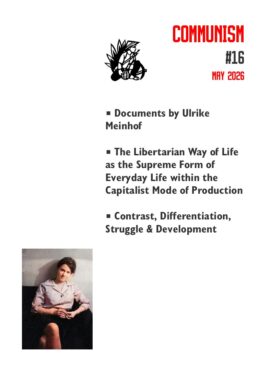
It is for this reason — for all these reasons — that our comrade Ulrike Meinhof was murdered in her prison cell on May 9, 1976, in Stuttgart-Stammheim.
That was fifty years ago — which is to say, a very long time ago. Nevertheless, one need only read the documents of the Red Army Faction to see that the « 24/7 » nature of capitalism had already been understood, denounced, and fought against.
We are not living the capitalism of the 1970s ; commodities are now ubiquitous, consumerism has become generalized, and mindsets have been molded accordingly.
That is why, fifty years later, paying tribute to the memory of Ulrike Meinhof means more than simply speaking about her; it means embracing the fact that we are human beings — and that we must become them!
Humanity’s historical transformation — which began with its departure from Nature — remains incomplete until it reaches communism, which constitutes, in turn, a return to Nature that preserves the gains achieved along the way.
This battle for the advancement of humanity — for its dignity, and in accordance with the need for communism — is precisely what Ulrike Meinhof championed.
We do not, therefore, intend here to offer a « final assessment » of her legacy; she herself had rightly emphasizedthat « taking a position » is often a mere formality — nothing more than a mask for passivity.
In reality, every act must constitute a stance, an affirmation, a connection — regardless of the specific actionundertaken or the level at which it occurs.
Under capitalism, everything is necessarily a battle — for capitalism is inherently dehumanizing, and seeks, moreover, to obstruct the transition to socialism and communism. Capitalism drags us backward and bars our path to the future!
We must, therefore, view everything through a dialectical lens and embrace the concept of People’s War — whether within the immediate context of class struggle, in the effort to sustain a relationship as a couple, in establishing a proper relationship with animals, in recognizing that women hold up « half the sky, » in learning to appreciate and cultivate culture, or in striving for one’s own personal fulfillment.